

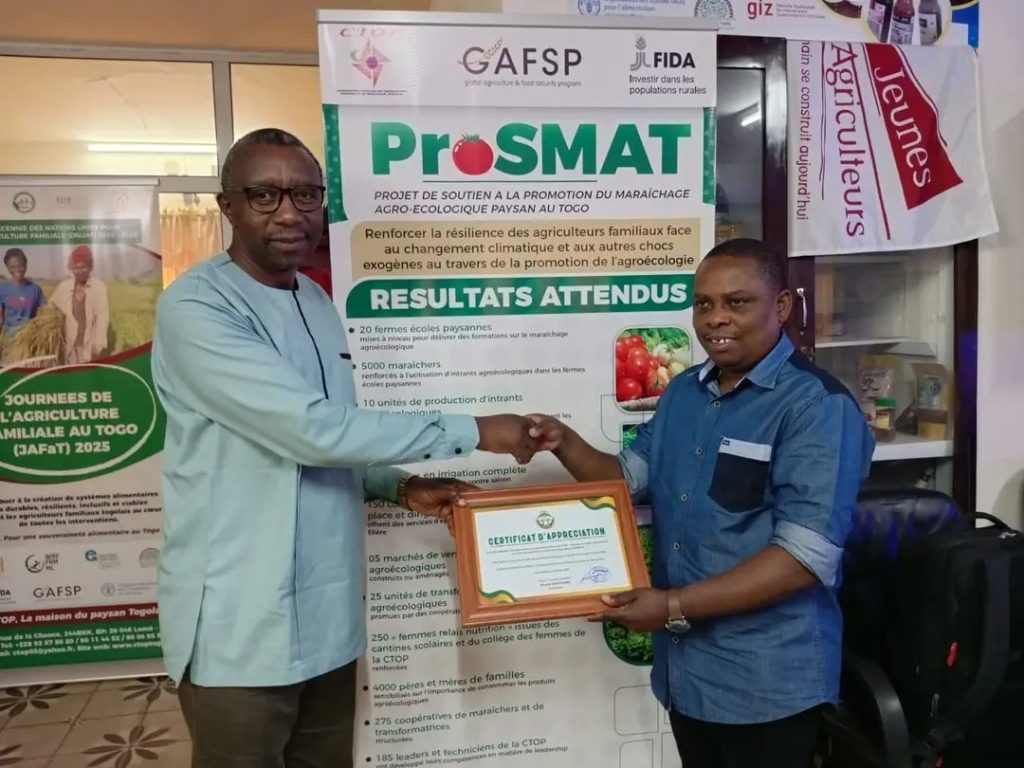
As part of the implementation of SCORE RWANDA Project funded by the Global Agriculture and Food Security Program (GAFSP) under the supervision of the International Fund for Agricultural Development (IFAD), the Togolese Coordination of Farmers’ and Agricultural Producers’ Organizations (CTOP) had the honor of hosting a delegation from INGABO Farmers’ Syndicate from Rwanda for a study visit and experience-sharing mission held from March 21 to 27, 2026, in Togo.
The overall objective of this mission was to strengthen the technical and organizational capacities of INGABO Farmers’ Syndicate in implementing the SCORE Rwanda Project, through dynamic exchanges with CTOP and key stakeholders involved in the ProSMAT Project.
More specifically, participants were able to:
- Analyze best practices and innovations implemented by CTOP within GAFSP-funded projects;
- Deepen their understanding of governance, monitoring & evaluation, and financial management systems applied in IFAD/GAFSP-supported initiatives;
- Exchange on effective strategies for promoting cassava value chains, strengthening seed production, and scaling up agroecological practices;
- Identify opportunities for technical and institutional cooperation between INGABO and CTOP;
- Capture and capitalize on key lessons learned for integration into the SCORE Project in Rwanda…
An exchange visit was carried out by 3 Project staff members (Project Coordinator, Accountant and Monitoring & Evaluation Officer) to CTOP, a Togolese farmers’ organization, from which the following insights were gained:
| Theme | Lessons Learned |
| Governance and Organizational Strengthening | Clarification of roles across levels (local, regional, national); Accountability and transparency mechanisms; Professionalization of farmer leadership; Clear division of roles between CTOP and member organizations with responsibility sharing in PRoSMAT management (“Do – delegate – collaborate”). |
| Advocacy, Representation, and Political Influence | Structuring advocacy based on field data; Active participation in national consultation platforms; Close relationships with public authorities (Ministry of Agriculture, Ministry of Environment). |
| Development of Inclusive Economic Services for Members, especially Women and Youth | Establishment of economic services (inputs, credit, marketing); Technical support (training, agricultural advice, farmer field schools); Value chain development (e.g., rice, maize, soya, horticultural crops); Diversification of cassava by-products (tapioca, gari, animal feed) and collaboration with KINAZI Cassava Plant; Cassava cutting conservation techniques (up to three months). |
| Partnerships and Resource Mobilization | Develop appropriate fundraising strategies; Strengthen institutional credibility to attract partners; Engagement in regional and international programs. |
| Youth and Women Inclusion | Specific programs for young farmers; Female leadership in decision-making bodies; Innovation (digital agriculture, rural incubators). |
| Communication and Visibility | Develop a dedicated communication strategy for the GAFSP/SCORE Rwanda project (media, social networks, project logo, etc.); Highlight member successes; Produce professional reports and documents for donors; Explore communication tools to identify the most suitable ones. |
| GAFSP Project Management | Project leadership by member organizations with reporting to CTOP; Project flexibility for greater impact (simple measurable indicators, regular data collection, budget revisions for project impact); Improve capitalization and visibility of project results (communication strategy, testimonials, case studies, success stories); Ensure partner awareness of the project; Secure learning plots; Create synergies with IFAD-funded projects (gender, financial literacy, etc.); Communication sheets for each activity; Proper supervision preparation to enhance project performance and impact; Production of high-quality reports and project documents. |
| Financial Management | Close follow-up on audit recommendations (implementation plan); Review accounting software for better performance (budget analysis, reporting, etc.). |
| Environment and Resilience | Maintain contact with NGO AGIDE to explore collaboration on environmental education and plant resilience through natural mechanisms: 1) Soil fungi creation, 2) Reduction of evapotranspiration; Explore possibilities to deliver products to Rwanda. |
This South–South collaboration highlighted Togo’s strong expertise in agro ecology and farmer organization, while offering practical pathways to enhance the resilience of smallholder farmers in Rwanda in the face of food security and climate challenges.
